Books like The language mechanic by C. Block


Designed for grades 4‑7, The Language Mechanic blends concise rule explanations with practical, hands‑on activities to help students grasp the logic behind English grammar and punctuation. Each lesson opens with a humorous miscommunication that illustrates why a rule matters, followed by a clear rule description, an analysis of its underlying logic, and both guided and independent practice. The book also offers presentation and reinforcement suggestions, answers, a glossary, and a compare/contrast organizer to support teachers and self‑learners. Topics covered include capitalization, run‑ons, fragments, pronouns, modifiers, verbs, agreement, unnecessary words, punctuation, friendly letters, spelling, and vocabulary.
First publish date: 2000
Genre: Education & Language/Teaching
Authors: C. Block
★ ★ ★ ★ ★ 0.0 (0 community ratings)

The language mechanic by C. Block

How are these books recommended?

The books recommended for The language mechanic by C. Block are shaped by reader interaction. Votes on how closely books relate, user ratings, and community comments all help refine these recommendations and highlight books readers genuinely find similar in theme, ideas, and overall reading experience.


Have you read any of these books?
Your votes, ratings, and comments help improve recommendations and make it easier for other readers to discover books they’ll enjoy.

Books similar to The language mechanic (8 similar books)
An introduction to language by 6938342|Victoria A. Fromkin book cover

📘 An introduction to language

An Introduction to Language is a student-friendly, up-to-date guide covering the core components of linguistics—phonetics, phonology, morphology, syntax, semantics, and pragmatics—while integrating recent research on bilingualism, neurolinguistics, and sociolinguistics.

★★★★★★★★★★ 5.0 (2 ratings)
Similar? ✓ Yes 0 ✗ No 0
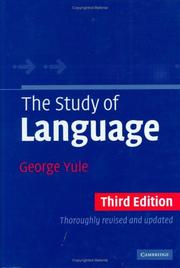
The study of language by 8842257|George Yule book cover

📘 The study of language

Unrivalled in its popularity, The Study of Language is quite simply the best introduction to the field available today. It introduces the analysis of the key elements of language - sounds, words, structures and meanings, and provides a solid foundation in all of the essential topics, such as how conversation works, child language, and language variation. This third edition has been extensively revised to include fresh study questions, a comprehensive glossary, and new sections on important contemporary issues in language study, including language and culture, slang, gestures, and African American English.

★★★★★★★★★★ 5.0 (1 rating)
Similar? ✓ Yes 0 ✗ No 0
Grammar, usage, and mechanics by 6919728|Holt Rinehart and Winston book cover

📘 Grammar, usage, and mechanics


★★★★★★★★★★ 0.0 (0 ratings)
Similar? ✓ Yes 0 ✗ No 0
Building thinking skills by 12210270|Michael Baker & Stephanie Stevens book cover

📘 Building thinking skills

A colorful, 224‑page curriculum that builds preschoolers’ critical‑thinking, vocabulary, and reasoning skills through engaging activities in reading, math, science, and social studies.

★★★★★★★★★★ 0.0 (0 ratings)
Similar? ✓ Yes 0 ✗ No 0
Language and mind by 7476011|Noam Chomsky book cover

📘 Language and mind

A comprehensive collection of Noam Chomsky’s essays tracing the biological basis of language and cognition, from Universal Grammar to contemporary biolinguistic challenges.

★★★★★★★★★★ 0.0 (0 ratings)
Similar? ✓ Yes 0 ✗ No 0
The natural approach by 6718907|Stephen D. Krashen book cover

📘 The natural approach

The Natural Approach is based on the following tenets: 1). Language acquisition (an unconscious process developed through using language meaningfully) is different from language learning (consciously learning or discovering rules about a language) and language acquisition is the only way competence in a second language occurs. (The acquisition/learning hypothesis) 2). Conscious learning operates only as a monitor or editor that checks or repairs the output of what has been acquired. (The monitor hypothesis) 3). Grammatical structures are acquired in a predictable order and it does little good to try to learn them in another order.(The natural order hypothesis). 4). People acquire language best from messages that are just slightly beyond their current competence. (The input hypothesis) 5). The learner's emotional state can act as a filter that impedes or blocks input necessary to acquisition. (The affective filter hypothesis)

★★★★★★★★★★ 0.0 (0 ratings)
Similar? ✓ Yes 0 ✗ No 0
Language universals and linguistic typology by 8796504|Bernard Comrie book cover

📘 Language universals and linguistic typology


★★★★★★★★★★ 0.0 (0 ratings)
Similar? ✓ Yes 0 ✗ No 0
Run-On Riddlers Level B Book 1 by 7199519|M. A. Hockett book cover

📘 Run-On Riddlers Level B Book 1

Grades 3-4 Rescues students from boring drill and practice. It gives them super powers in punctuation, grammar, usage, and reading comprehension for crystal clear communication. These unique activities will keep students engaged.

★★★★★★★★★★ 0.0 (0 ratings)
Similar? ✓ Yes 0 ✗ No 0

Some Other Similar Books

Language: The Cultural Tool by Daniel L. Everett
The Power of Babel: A Natural History of Language by John H. McWhorter
Languages and Their Speakers by William C. McCormack
The Language Instinct: How the Mind Creates Language by Steven Pinker
The Articulate Mammal: An Introduction to Psycholinguistics by Jean Aitchison
Foundations of Language: Brain, Meaning, Grammar, Evolution by Ray S. Jackendoff

Have a similar book in mind? Let others know!

Please login to submit books!