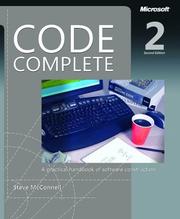
Code Complete
This book provides a strategic approach to software construction, offering essential techniques and must-know principles for creating high-qualit...
Is this book similar?
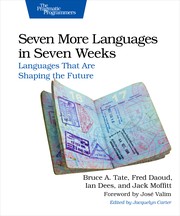
Books like this one
Learn from the award-winning programming series that inspired the Elixir language. Hear how other programmers across broadly different communities solve problems important enough to compel language development. Expand your perspective, and learn to solve multicore and distribution problems. In each language, you'll solve a non-trivial problem, using the techniques that make that language special. Write a fully functional game in Elm, without a single callback, that compiles to JavaScript so you can deploy it in any browser. Write a logic program in Clojure using a programming model, MiniKanren, that is as powerful as Prolog but much better at interacting with the outside world. Build a distributed program in Elixir with Lisp-style macros, rich Ruby-like syntax, and the richness of the Erlang virtual machine. Build your own object layer in Lua, a statistical program in Julia, a proof in code with Idris, and a quiz game in Factor. When you're done, you'll have written programs in five different programming paradigms that were written on three different continents. You'll have explored four languages on the leading edge, invented in the past five years, and three more radically different languages, each with something significant to teach you. With each passing day, it is becoming more likely that new programmers will use functional programming, an entirely new programming paradigm. Each of the new languages has something unique to teach the next generation of programmers. 1. To learn functional programming, learn functional composition first. Programmers who want to improve themselves are learning functional programming in increasing numbers. Factor is a great language for learning about the composition of functions. The concatenative language forces new users to think through how functions will work together. 2. If you want to learn JavaScript, learn how prototypes work first in a simpler language. New JavaScript programmers are often better off learning a language like Lua first, which has the same overall model but fewer distracting concepts than JavaScript. 3. You don't need callbacks to build a beautiful user interface. Reactive programming is a new style of user interface development that helps build highly interactive and reliable applications. The Elm programming language is a language with reactive concepts baked in, from the inside out, and it compiles to JavaScript. 4. To build better cloud applications, your applications need to know how to fail. Applications are becoming more distributed than ever before. Elixir is among the most promising young languages for building cloud applications that scale well and handle failure in a sensible, reliable way. Elixir combines the natural syntax of Ruby with Clojure-style macros, all on the Erlang virtual machine for distribution and failover. 5. Technical computing will hit the limitations of multicore architectures before most other programming branches will. Scientific computing is increasingly hitting a wall because existing languages don't take full advantage of multicore architecture. The Julia language is growing quickly, allowing familiar programming approaches but enabling much more scalable and powerful mathematical models without dropping into C++. 6. Use logic programming when you need to build applications that "think." You don't need to know Mercury or Prolog to write logic programs. If you find yourself needing to occasionally solve logic problems, use a library instead. MiniKanren is one such library that is available in languages like Haskell and Clojure. 7. You don't need to use Haskell, Agda or Idris to take advantage of advanced type theory in your everyday job. Sometimes, it's hard to see the forest for the trees. Languages like Idris are excellent for reasoning about typing. You can build a type model in Idris and adapt it to a language like C++. - Publisher.
Discover your next read
Compare books other readers have recommended. Vote to help improve these suggestions.
Looking for more books like Seven More Languages in Seven Weeks by Bruce Tate? This list brings together suggested alternatives and feedback from SimilarBooks readers. Ratings reflect what readers think of each individual book, while the Yes and No votes show whether visitors consider it a good match for this title. Compare the recommendations below and suggest another book to help fellow readers discover their next read.
This book provides a strategic approach to software construction, offering essential techniques and must-know principles for creating high-qualit...
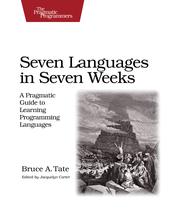

Benny Lewis delivers a practical guide for mastering a new language in three months, dispelling myths about memory and age while offering actiona...

After the mysterious 1980 death of literary critic Roland Barthes in Paris, a bumbling police detective is drawn into the hidden world of French ...

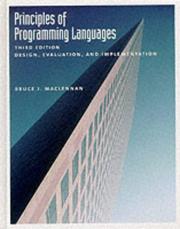
Essential guide to programming languages, focusing on design, evaluation, and implementation.
Programming languages (Electronic computers), Programmierung, Programmiersprache
Community ratings describe each book independently. Similarity votes measure whether readers consider a recommendation a good match for this particular title; results can change as more visitors share feedback.
Suggest another book below, or vote Yes or No on any existing recommendation.
Share your suggestion →Readers make discovery better
Share a recommendation and help other readers discover their next great read.