Books like Portraits from memory by Bertrand Russell


First publish date: 1956
Authors: Bertrand Russell
0.0 (0 community ratings)

Portraits from memory by Bertrand Russell

How are these books recommended?

The books recommended for Portraits from memory by Bertrand Russell are shaped by reader interaction. Votes on how closely books relate, user ratings, and community comments all help refine these recommendations and highlight books readers genuinely find similar in theme, ideas, and overall reading experience.


Have you read any of these books?
Your votes, ratings, and comments help improve recommendations and make it easier for other readers to discover books they’ll enjoy.

Books similar to Portraits from memory (7 similar books)
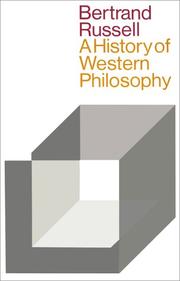
A history of western philosophy by 1410756|Bertrand Russell book cover

πŸ“˜ A history of western philosophy

Bertrand Russell presents Western philosophy as a living part of society, showing how ideas shape, and are shaped by, the political and social life of different communities.

β˜…β˜…β˜…β˜…β˜…β˜…β˜…β˜…β˜…β˜… 4.1 (21 ratings)
Similar? ✓ Yes 0 ✗ No 0
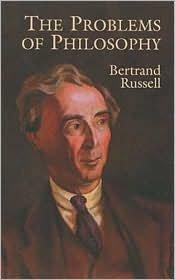
The Problems of Philosophy by 1410756|Bertrand Russell book cover

πŸ“˜ The Problems of Philosophy

A concise exploration of Bertrand Russell’s key philosophical questions, focusing primarily on epistemology while briefly addressing metaphysics and other contemporary issues.

β˜…β˜…β˜…β˜…β˜…β˜…β˜…β˜…β˜…β˜… 3.4 (5 ratings)
Similar? ✓ Yes 0 ✗ No 0
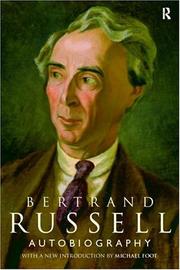
Autobiography by 1410756|Bertrand Russell book cover

πŸ“˜ Autobiography

Bertrand Russell’s six‑volume autobiography traces his life from birth in 1872 to death in 1970, covering his intellectual development, wartime experiences, and philosophical contributions.

β˜…β˜…β˜…β˜…β˜…β˜…β˜…β˜…β˜…β˜… 4.2 (5 ratings)
Similar? ✓ Yes 0 ✗ No 0
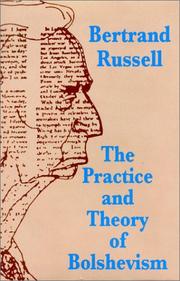
The Practice and Theory of Bolshevism by 1410756|Bertrand Russell book cover

πŸ“˜ The Practice and Theory of Bolshevism


β˜…β˜…β˜…β˜…β˜…β˜…β˜…β˜…β˜…β˜… 3.0 (1 rating)
Similar? ✓ Yes 0 ✗ No 0
My Philosophical Development by 1410756|Bertrand Russell book cover

πŸ“˜ My Philosophical Development

Russell gives an account of his philosophical development. He describes his Hegelian period and includes hitherto unpublished notes for a Hegelian philosophy of science. He deals next with the two-fold revolution involved with his abandonment of idealism and adoption of a mathematical logic founded upon that of Giuseppe Peano. After two chapters on Principia Mathematica (1910-1913), he passes to the problems of perception as dealt with in Our Knowledge of the External World (1914). In a chapter on β€˜The Impact of Wittgenstein’, Russell examines what he now thinks must be accepted and what rejected in that philosopher's work. He notes the changes from earlier theories required by the adoption of William James's view that sensation is not essentially relational and is not per se a form of knowledge. In an explanatory chapter, he endeavours to remove misconceptions of and objections to his theories as to the relation of perception to scientific knowledge. Russell concludes with a reprint of some articles on modern Oxford philosophy.

β˜…β˜…β˜…β˜…β˜…β˜…β˜…β˜…β˜…β˜… 0.0 (0 ratings)
Similar? ✓ Yes 0 ✗ No 0
The collected stories of Bertrand Russell by 1410756|Bertrand Russell book cover

πŸ“˜ The collected stories of Bertrand Russell


β˜…β˜…β˜…β˜…β˜…β˜…β˜…β˜…β˜…β˜… 0.0 (0 ratings)
Similar? ✓ Yes 0 ✗ No 0
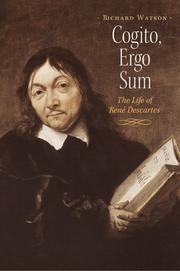
Cogito, Ergo Sum by 5946361|Richard Watson book cover

πŸ“˜ Cogito, Ergo Sum

"Rene Descartes is the philosophical architect of our modern world. In metaphysics, he established the view that mind and body are distinct substances, a position foundational for any belief that the human soul is immortal. In mathematics, he invented analytic geometry - the basis of calculus - which makes physics as we know it possible. Descartes perfected the method of proposing and testing hypotheses with experiments that anyone can repeat, which forms the basis of modern science. In optics, he discovered and described laws of refraction and reflection. In medicine, he was a pioneer in vivisection and anatomical description for understanding the human body. In physiology, his analysis of the relations among the sense organs, nerves, and the brain is still taught today. In psychology, he discovered conditioned reflexes and investigated the role of the emotions in human behavior. Descartes said there was no point in trying to refute Aristotelian Scholasticism; rather, he would simply show a better way. Some 350 years after his death, our twenty-first-century world - from mind-body dualism to heart pumps, from pop psychology to personal computers - is thoroughly Cartesian. Nothing in the modern world would alarm or surprise him were he alive today."--BOOK JACKET.

β˜…β˜…β˜…β˜…β˜…β˜…β˜…β˜…β˜…β˜… 0.0 (0 ratings)
Similar? ✓ Yes 0 ✗ No 0

Some Other Similar Books

Human Knowledge: Its Scope and Limits by Bertrand Russell
Western Philosophy: An Anthology by Bertrand Russell
Power: A New Social Analysis by Bertrand Russell
Bertrand Russell: A Free Man's Life by Ray Monk

Have a similar book in mind? Let others know!

Please login to submit books!