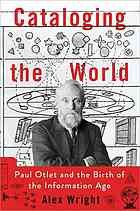
"The dream of universal knowledge hardly started with the digital age. From the archives of Sumeria to the Library of Alexandria, humanity has long wrestled with information overload and management of intellectual output. Revived during the Renaissance and picking up pace in the Enlightenment, the dream grew and by the late nineteenth century was embraced by a number of visionaries who felt that at long last it was within their grasp. Among them, Paul Otlet stands out. A librarian by training, he worked at expanding the potential of the catalogue card -- the world's first information chip. From there followed universal libraries and reading rooms, connecting his native Belgium to the world -- by means of vast collections of cards that brought together everything that had ever been put to paper. Recognizing that the rapid acceleration of technology was transforming the world's intellectual landscape, Otlet devoted himself to creating a universal bibliography of all published knowledge. Ultimately totaling more than 12 million individual entries, it would evolve into the Mundaneum, a vast "city of knowledge" that opened its doors to the public in 1921. By 1934, Otlet had drawn up plans for a network of "electric telescopes" that would allow people everywhere to search through books, newspapers, photographs, and recordings, all linked together in what he termed a réseau mondial: a worldwide web. It all seemed possible, almost until the moment when the Nazis marched into Brussels and carted it all away. In Cataloging the World, Alex Wright places Otlet in the long continuum of visionaries and pioneers who have dreamed of unifying the world's knowledge, from H.G. Wells and Melvil Dewey to Ted Nelson and Steve Jobs. And while history has passed Otlet by, Wright shows that his legacy persists in today's networked age, where Internet corporations like Google and Twitter play much the same role that Otlet envisioned for the Mundaneum -- as the gathering and distribution channels for the world's intellectual output. In this sense, Cataloging the World is more than just the story of a failed entrepreneur; it is an ongoing story of a powerful idea that has captivated humanity from time immemorial, and that continues to inspire many of us in today's digital age"-- Provided by publisher.
"In 1934, a Belgian entrepreneur named Paul Otlet sketched out plans for a worldwide network of computers--or "electric telescopes," as he called them -- that would allow people anywhere in the world to search and browse through millions of books, newspapers, photographs, films and sound recordings, all linked together in what he termed a réseau mondial: a "worldwide web." Today, Otlet and his visionary proto-Internet have been all but forgotten, thanks to a series of historical misfortunes -- not least of which involved the Nazis marching into Brussels and destroying most of his life's work. In the years since Otlet's death, however, the world has witnessed the emergence of a global network that has proved him right about the possibilities -- and the perils -- of networked information. In The Web that Wasn't, Alex Wright brings to light the forgotten genius of Paul Otlet, an introverted librarian who harbored a bookworm's dream to organize all the world's information. Recognizing the limitations of traditional libraries and archives, Otlet began to imagine a radically new way of organizing information, and undertook his life's great work: a universal bibliography of all the world's published knowledge that ultimately totaled more than 12 million individual entries. That effort eventually evolved into the Mundaneum, a vast "city of knowledge" that opened its doors to the public in 1921 to widespread attention. Like many ambitious dreams, however, Otlet's eventually faltered, a victim to technological constraints and political upheaval in Europe on the eve of World War II. "-- Provided by publisher.
First publish date: 2014
Subjects: History, Biography, Information science, Classification, Books
The books recommended for Cataloging the world by
Alex Wright are shaped by reader interaction.
Votes on how closely books relate, user ratings, and community comments all help
refine these recommendations and highlight books readers genuinely find similar
in theme, ideas, and overall reading experience.
Have you read any of these books?
Your votes, ratings, and comments help improve recommendations and make it easier
for other readers to discover books they’ll enjoy.
Books similar to Cataloging the world (4 similar books)
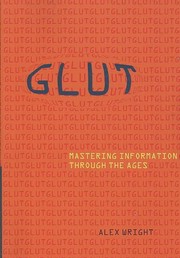
What do primordial bacteria, medieval alchemists, and the World Wide Web have to do with each other? This fascinating exploration of how information systems emerge takes readers on a provocative journey through the history of the information age.
Spanning disciplines from evolutionary theory and cultural anthropology to the history of books, libraries, and computer science, writer and information architect Alex Wright weaves an intriguing narrative that connects such seemingly far-flung topics as insect colonies, Stone Age jewelry, medieval monasteries, Renaissance encyclopedias, early computer networks, and the World Wide Web. Finally, he pulls these threads together to reach a surprising conclusion, suggesting that the future of the information age may lie deep in our cultural past.
Source:
http://web.archive.org/web/20160401102534/http://www.alexwright.org/glut
Brings to life the true story of an American doctor and his family in Paris, and his heroic espionage efforts during World War II. Exclusive Avenue Foch was Paris's hotbed of spies, secret police, informers, and Vichy collaborators. So when the couple at number 11--American physician Sumner Jackson and his Swiss-born wife Toquette--joined the French resistance, they knew the stakes were extraordinarily high. They would be risking not only their own lives but that of their only child, twelve-year-old Phillip. There was no more dangerous place in all of occupied Europe than their street: Nazis had commandeered almost every building. At number 31 was the "mad sadist" Theodor Dannecker, charged with deporting French Jews to concentration camps. Number 72 housed the Parisian headquarters of the Gestapo. As their Nazi neighbors rounded up Jews and ruthlessly destroyed all opposition, the Jacksons stepped up their own private war against Hitler. From the American Hospital, Sumner smuggled fallen Allied crewmen out of France. And Toquette agreed to allow the Goélette network of the resistance to use their home as a drop box for vital information en route to Britain. As D-Day neared, the noose began to tighten: when the family's secret was finally discovered, they were sent on a journey into the black heart of the war-torn continent from which there was little chance of return. Drawing upon a wealth of primary source material and extensive interviews with Phillip Jackson, Alex Kershaw re-creates the City of Light during its darkest days.--Adapted from book jacket.
Metadata: Unlocking the Data Economy by Brian Clifton The History of Cataloging and Metadata by Jennifer E. Huber Cataloging Resources and Sources by Luciana Duranti Understanding Metadata by Karen E. Coyle The Organization of Information by Daniel J. LeMoine Encoding and Metadata for Digital Preservation by Michael Beattie Metadata for Information Management by Adrien Champion Linked Data and the Semantic Web by Tom Heath Information Architecture: For the Web and Beyond by Peter Morville Introduction to Metadata by R. David Lankes
Have a similar book in mind? Let others know!
Please login to submit books!
Is it a similar book?
Thank you for sharing your feedback. Please also let us know why you're thinking this is a similar (or not similar) book.