Books like Between debt and the devil by Adair Turner


First publish date: 2015
Authors: Adair Turner
★ ★ ★ ★ ★ 0.0 (0 community ratings)

Between debt and the devil by Adair Turner

How are these books recommended?

The books recommended for Between debt and the devil by Adair Turner are shaped by reader interaction. Votes on how closely books relate, user ratings, and community comments all help refine these recommendations and highlight books readers genuinely find similar in theme, ideas, and overall reading experience.


Have you read any of these books?
Your votes, ratings, and comments help improve recommendations and make it easier for other readers to discover books they’ll enjoy.

Books similar to Between debt and the devil (6 similar books)

The road to ruin by 11334522|James Rickards book cover

πŸ“˜ The road to ruin

James Rickards warns of a looming global financial collapse driven by elite banks and governments, urging investors to prepare for potential market shutdowns, asset freezes, and cash shortages with a blend of behavioral economics, history, and complexity theory.

β˜…β˜…β˜…β˜…β˜…β˜…β˜…β˜…β˜…β˜… 5.0 (2 ratings)
Similar? ✓ Yes 0 ✗ No 0
Firefighting by 11979792|Ben S. Bernanke book cover

πŸ“˜ Firefighting


β˜…β˜…β˜…β˜…β˜…β˜…β˜…β˜…β˜…β˜… 4.0 (1 rating)
Similar? ✓ Yes 0 ✗ No 0
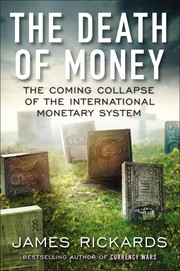
The Death of Money by 11334522|James Rickards book cover

πŸ“˜ The Death of Money

The next financial collapse will resemble nothing in history. Deciding upon the best course to follow will require comprehending a minefield of risks, while poised at a crossroads, pondering the death of the dollar. The international monetary system has collapsed three times in the past hundred years, in 1914, 1939, and 1971. Each collapse was followed by a period of tumult: war, civil unrest, or significant damage to the stability of the global economy. Now James Rickards, the acclaimed author of Currency Wars, shows why another collapse is rapidly approaching and why this time, nothing less than the institution of money itself is at risk. The American dollar has been the global reserve currency since the end of the Second World War. If the dollar fails, the entire international monetary system will fail with it. No other currency has the deep, liquid pools of assets needed to do the job. Optimists have always said, in essence, that there's nothing to worry about -- that confidence in the dollar will never truly be shaken, no matter how high our national debt or how dysfunctional our government. But in the last few years, the risks have become too big to ignore. While Washington is gridlocked and unable to make progress on our long-term problems, our biggest economic competitors -- China, Russia, and the oil-producing nations of the Middle East -- are doing everything possible to end U.S. monetary hegemony. The potential results: Financial warfare. Deflation. Hyperinflation. Market collapse. Chaos. Rickards offers a bracing analysis of these and other threats to the dollar. The fundamental problem is that money and wealth have become more and more detached. Money is transitory and ephemeral, and it may soon be worthless if central bankers and politicians continue on their current path. But true wealth is permanent and tangible, and it has real value worldwide. The author shows how everyday citizens who save and invest have become guinea pigs in the central bankers' laboratory. The world's major financial players -- national governments, big banks, multilateral institutions -- will always muddle through by patching together new rules of the game. The real victims of the next crisis will be small investors who assumed that what worked for decades will keep working. Fortunately, it's not too late to prepare for the coming death of money. Rickards explains the power of converting unreliable money into real wealth: gold, land, fine art, and other long-term stores of value. As he writes: "The coming collapse of the dollar and the international monetary system is entirely foreseeable. Only nations and individuals who make provision today will survive the maelstrom to come." - Publisher.

β˜…β˜…β˜…β˜…β˜…β˜…β˜…β˜…β˜…β˜… 5.0 (1 rating)
Similar? ✓ Yes 0 ✗ No 0
All the Devils Are Here by 4562248|Bethany McLean book cover

πŸ“˜ All the Devils Are Here

Bethany McLean’s investigative nonfiction pulls back the curtain on the 2008 financial crisis, tracing how CEOs, politicians, lenders, and regulators orchestrated the collapse of Wall Street and the mortgage industry.

β˜…β˜…β˜…β˜…β˜…β˜…β˜…β˜…β˜…β˜… 5.0 (1 rating)
Similar? ✓ Yes 0 ✗ No 0
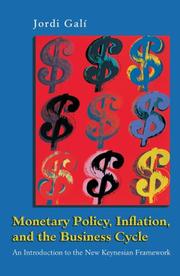
New perspectives on monetary policy, inflation and the business cycle by 12899668|Jordi Galí book cover

πŸ“˜ New perspectives on monetary policy, inflation and the business cycle

The New Keynesian framework has emerged as the workhorse for the analysis of monetary policy and its implications for inflation, economic fluctuations, and welfare. It is the backbone of the new generation of medium-scale models under development at major central banks and international policy institutions, and provides the theoretical underpinnings of the inflation stability-oriented strategies adopted by most central banks throughout the industrialized world. This graduate-level textbook provides an introduction to the New Keynesian framework and its applications to monetary policy. Using a canonical version of the New Keynesian model as a reference framework, Jordi GalοΏ½ explores issues pertaining to the design of monetary policy, including the determination of the optimal monetary policy and the desirability of simple policy rules. He analyzes several extensions of the baseline model, allowing for cost-push shocks, nominal wage rigidities, and open economy factors. In each case, the implications for monetary policy are addressed, with a special emphasis on the desirability of inflation targeting policies. The most up-to-date and accessible introduction to the New Keynesian framework available Uses a single benchmark model throughout Concise and easy to use Includes exercises An ideal resource for graduate students, researchers, and market analysts --front flap

β˜…β˜…β˜…β˜…β˜…β˜…β˜…β˜…β˜…β˜… 0.0 (0 ratings)
Similar? ✓ Yes 0 ✗ No 0
The curse of cash by 7417618|Kenneth S. Rogoff book cover

πŸ“˜ The curse of cash

The world is drowning in cash--and it's making us poorer and less safe. In The Curse of Cash, Kenneth Rogoff, one of the world's leading economists, makes a persuasive and fascinating case for an idea that until recently would have seemed outlandish: getting rid of most paper money.--Amazon.com

β˜…β˜…β˜…β˜…β˜…β˜…β˜…β˜…β˜…β˜… 0.0 (0 ratings)
Similar? ✓ Yes 0 ✗ No 0

Some Other Similar Books

The Big Debt Crisis by Highlighting the lessons from financial crises
This Time Is Different: Eight Centuries of Financial Folly by Carmen Reinhart and Kenneth Rogoff
The Dynamics of International Debt by Stephen G. Hall
The Rise and Fall of Nations: Forces of Change in the Post-Crisis World by Ruchir Sharma
Fault Lines: How Hidden Fractures Still Threaten the World Economy by Raghuram Rajan
Crisis Economics: A Crash Course in the Future of Finance by Nouriel Roubini and Stephen Mihm
The Great Rebalancing: Trade, Conflict, and the Perilous Road Ahead for the World Economy by Michael Pettis
The Globalization of Inequality by Branko Milanovic
The Age of Oversupply: Overcoming the Greatest Challenge to the Global Economy by Daniel Alpert

Have a similar book in mind? Let others know!

Please login to submit books!